
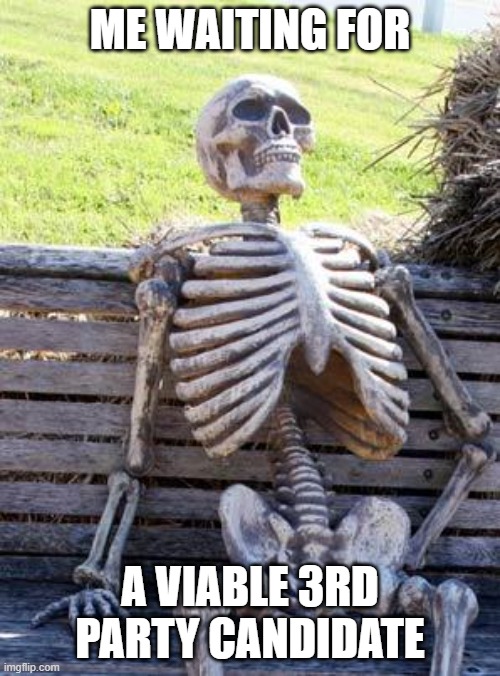
Here in the good ol’ US of A, people are always saying how they wish we had third parties. But we have lots of them. A couple dozen in fact, even more if you include various State specific parties. But they seem to do very little except take your money every four years when they pretend they have real shot at winning the presidential election. That’s because third parties are a joke and your votes are wasted on them.
Congress only has three independents in the Senate, Bernie Sanders, Kyrsten Sinema, and Angus King, and apparently none in the House. Sinema ran and got elected as Democrat then switched so she could pretend she’s just a maverick independent thinker after she helped tank progressive legislation for her Big Pharma donors. While King and Sanders were both elected as Independents, they caucus with the Democrats. And the only reason Sanders ran such successful and influential presidential campaigns is because he ran as Democrat. That’s not because Democrats inherently have politics better than the Greens, let’s say, but because they have money and an established electoral infrastructure. So even the members of Congress who aren’t technically affiliated with a major party are also not affiliated with any other party. There have been four times as many people on the Moon and almost seven times more people get struck by lightning annually than there are independents -let alone third party members- in Congress.
Surely, things must be better at the State level, right? After all, local races are easier than national ones and can be decided just a handful of votes. Not really. There are 7,386 state legislature seats in the US and only 94 of those are “independent, other, or vacant.” Most of those are Independents, some of whom ran as established party members then left like Sinema, a few are Libertarians -some of whom also left their parties after being elected- then a couple more from various other parties. 676 people have been to space, 116 people have served on the Supreme Court, four fucks sack, Game of Thrones has more named characters than there are third party spots in Congress.
There’s been a handful of times where third party candidates out performed expectations in presidential elections, but at best they accomplished literally nothing while at worst they acted as a spoiler and tarnishing the idea of third party runs altogether. Not one has ever won the presidency -no, Lincoln wasn’t third party– and most don’t even achieve ballot access in every state.
Ross Perot had the most successful third party run, certainly in modern history and living memory. Almost 20 million people, 18.9% of the country, voted for Perot in the 1992 election. He spent tens of millions of dollars of his own money, aired infomercials, had his name on the ballot in every state; he won no electoral votes and carried no states. He ran again in 1996 and won less than half the votes he won last time.
To be fair, third parties have a lot to contend with, first and foremost is first-past-the-post voting: whoever gets a plurality of the votes wins, which makes sense until you consider the spoiler effect. A simple example: three candidates run, the Democrat gets 40% of the vote, a Green candidate who shares a number of policy positions with the Democrat gets 15% and the Republican that shares no policies with either of them gets the remaining 45%. Well 55% of voters wanted someone who supports what the Democrat and Green supported, but they lost. There’s also the issue of how people perceive third party candidates, in no small part because of the spoiler effect, as unserious and incapable of winning. That’s not all third parties need to contend with: sometimes policies and platforms overlap significantly with the stated (if not always achieved or even fought for) policies and platforms of major parties; the two major parties also have name recognition, media attention, ballot access in every state, and war chests with more money than the GDP of entire countries.
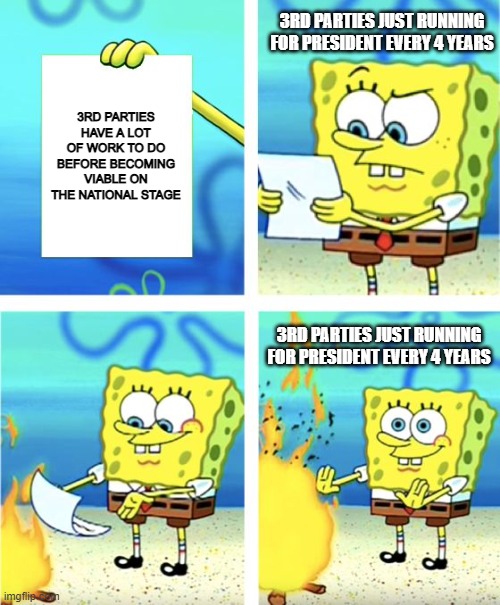
To be more fair, if a third party candidate has no strategy to overcome all these obstacles other than magically expecting people rally to them in en masse, they don’t deserve, and are unfit, to be president. For most people, third parties are like February 29th, they see them once every four years, it’s kind of neat, except third parties ask you for money. If they want to be taken seriously they need to do more than show up during presidential elections expecting they have a chance with almost no groundwork.
They could, and should, start with a single state, focus all the funds there, keep pushing for ranked chance voting which would remove lots of the aforementioned barriers, build up a loyal voting base, prove both their viability and seriousness. Turn just one state Green. Then keep doing it in others. If they want to run a presidential candidate before they even try laying the groundwork run in one of major parties like Sanders did and while its still a long-shot, if they win the nomination they managed to overcome the issues of ballot access, limited campaign finances, media exposure, name recognition, first-past-the-post, and the spoiler effect.
If for some misguided, vote-your-conscience purity, bullshit reason you still feel inclined to vote for these people outside of a primary, or local race, I honestly don’t know what you’re expecting to happen. Maybe you don’t expect them to win, but instead want to use it at a protest vote, a chance to show the the mainstream parties they need to earn your vote (which they should, but don’t) how’d that work out for the Left in 2016? Did those protest votes for Jill Stein move the Democrats further left? Did they decide to run better candidates? Did they decide to run on more than “Trump Bad?” No, they blamed Jill Stein voters for Trump’s electoral win and continued doing the exact same shit. It’s almost like they’re out of touch oligarchs who would rather see Trump win again than fundamentally change anything.
It’s a grim assessment of our political reality, but you’re not voting for who’s gonna be your spouse, or best friend, you’re voting for your opponent: who do you want the obstacle to change and a better world to be?
~David T.K.~

 The Iron Astrolabe